Jerte once again
My experiences in the Jerte valley have taught me to reflect on the way time and location can align in powerfully significant ways on our path through life. Few natural spectacles have moved me more than seeing the cherry orchards in bloom in this rugged bucolic region –Extremadura– whose name alludes to its marginality: on the “hard, extreme” edge separating two countries –Spain and Portugal– that have lived historically with their backs to each other. The name conveys a very unwarranted sense of outpost, where one goes only for personal reasons: such as the many families in Madrid whose grandparents formed part of the great migration of the 1950s and 60s, country folk seeking a better life in a capital that was merely beginning to boom. Our porteros in the various apartments we have lived in have often fallen into this group. Like so many Madrileños, they speak fondly of their pueblo: their ancestral homeland, the vast España vacía that so many look upon today with nostalgia and a sense of loss. Pedro Almodóvar offers a brilliant tribute to all this in his 2008 Volver.
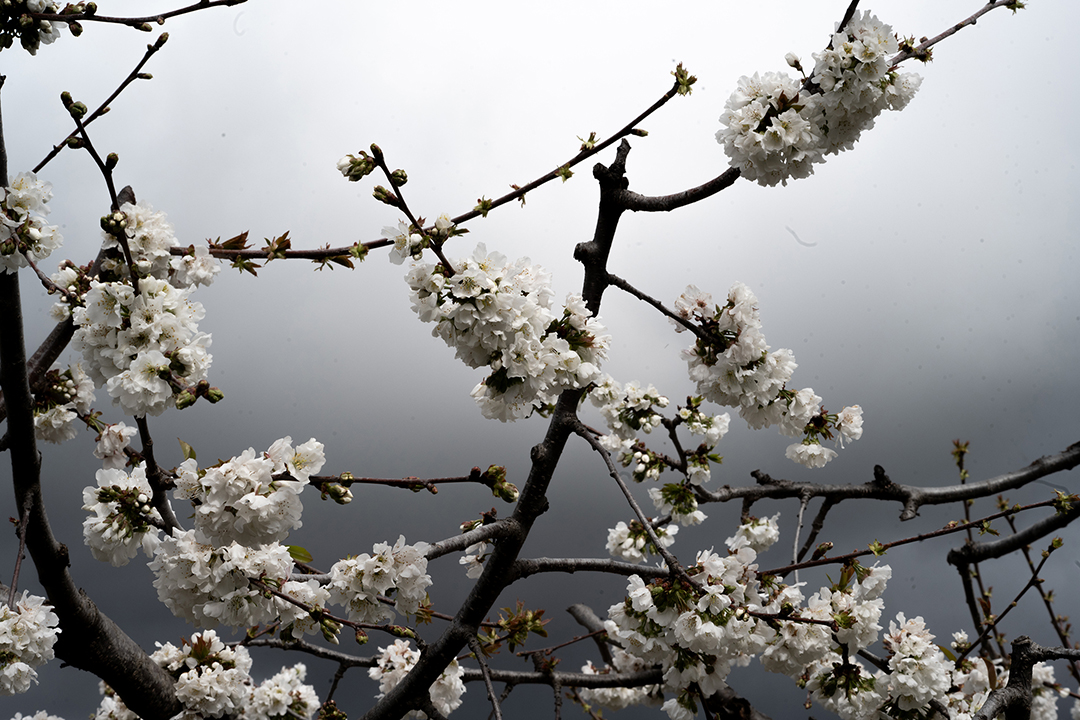
Maybe this is what drives me to “volver” once and again to Jerte, where I continue to partake of the cyclical festival of white blossoms exploding against the backdrop of a relatively unspoiled countryside, where I can learn from people whose lives still unfold in relatively traditional patterns, who still appreciate their timeless cuisine and still garnish their migas, patatas revoconas and caldereta de cabra with the pimentón that was an unwanted sign for me of my underclass: the child of an immigrant father who insisted on frying pimentón laden Spanish chorizo along with our eggs for Sunday breakfast. It is embarrassing for me to acknowledge how long it took me to appreciate what has now become part and parcel of Spain’s world class cuisine. Buying pimentón from local farmers, gazing out at the fields and reflecting on my interior life –on how it has evolved over time… these are all crucial byproducts of my returning to witness the cyclical magic of Extremadura’s cerezos en flor (cherry trees in bloom)!
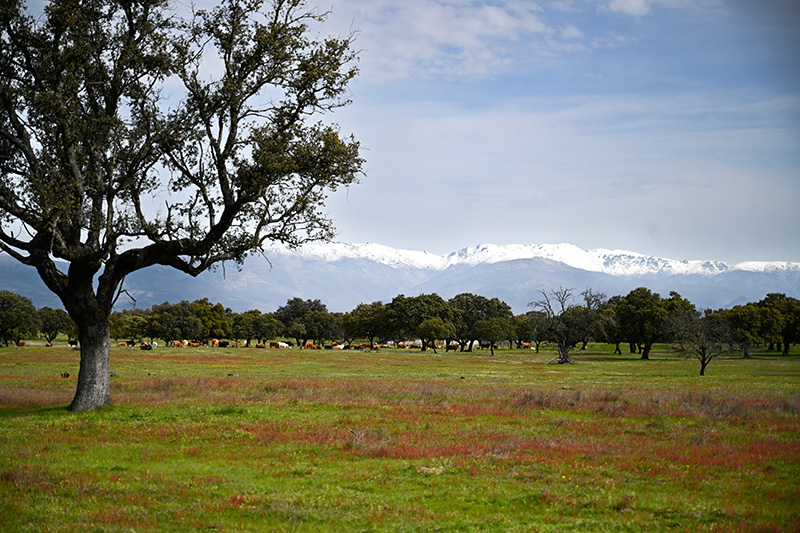
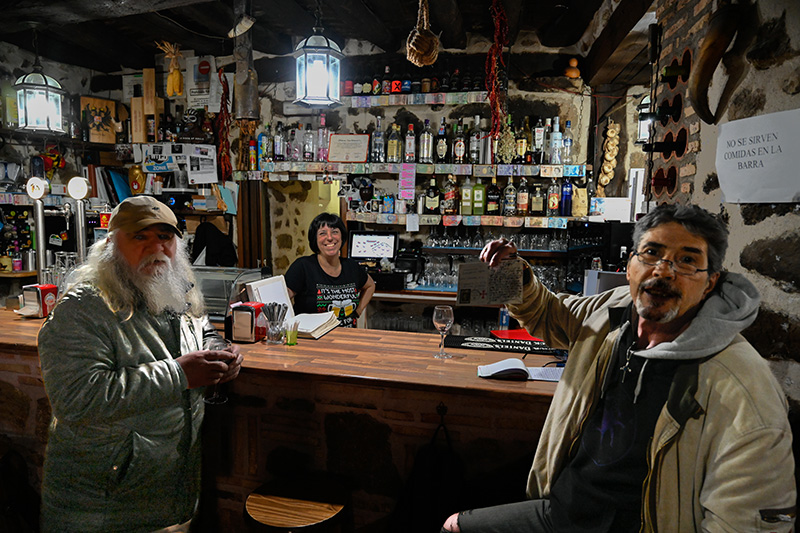
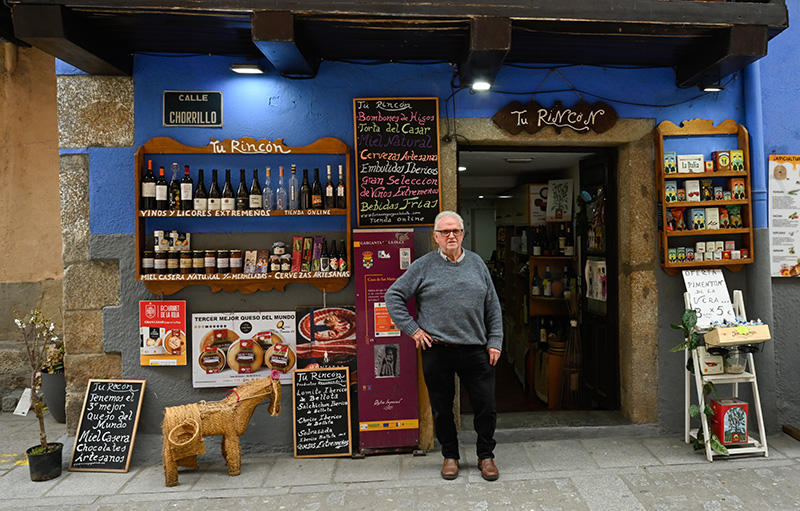
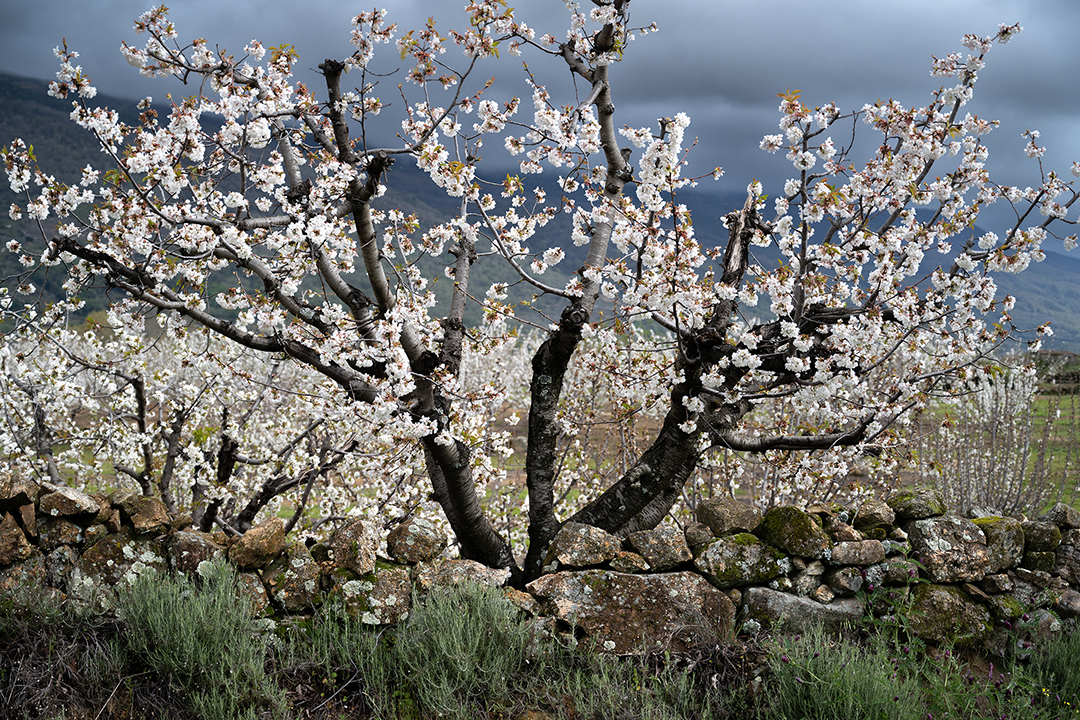
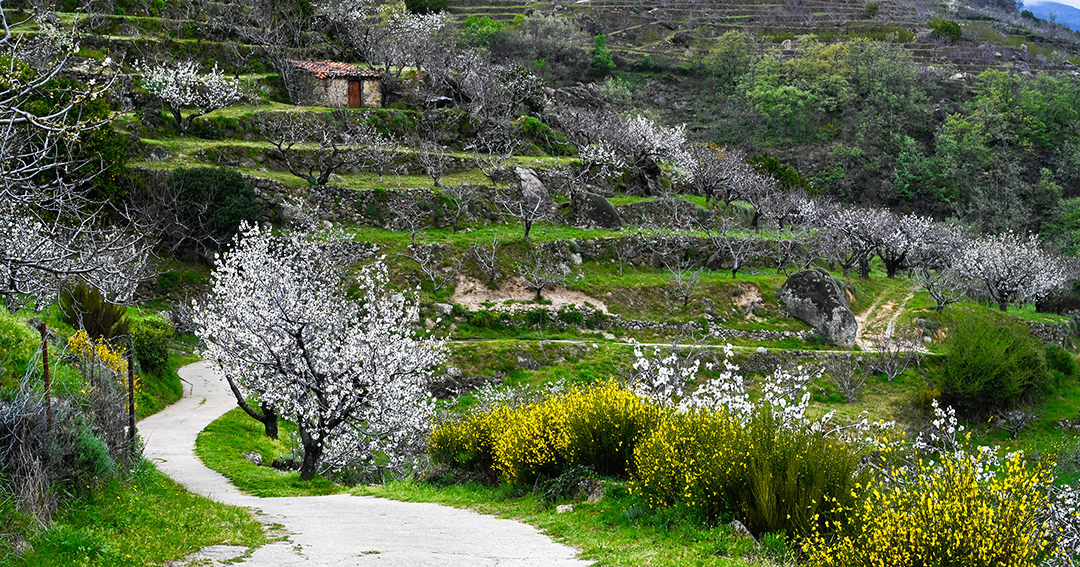
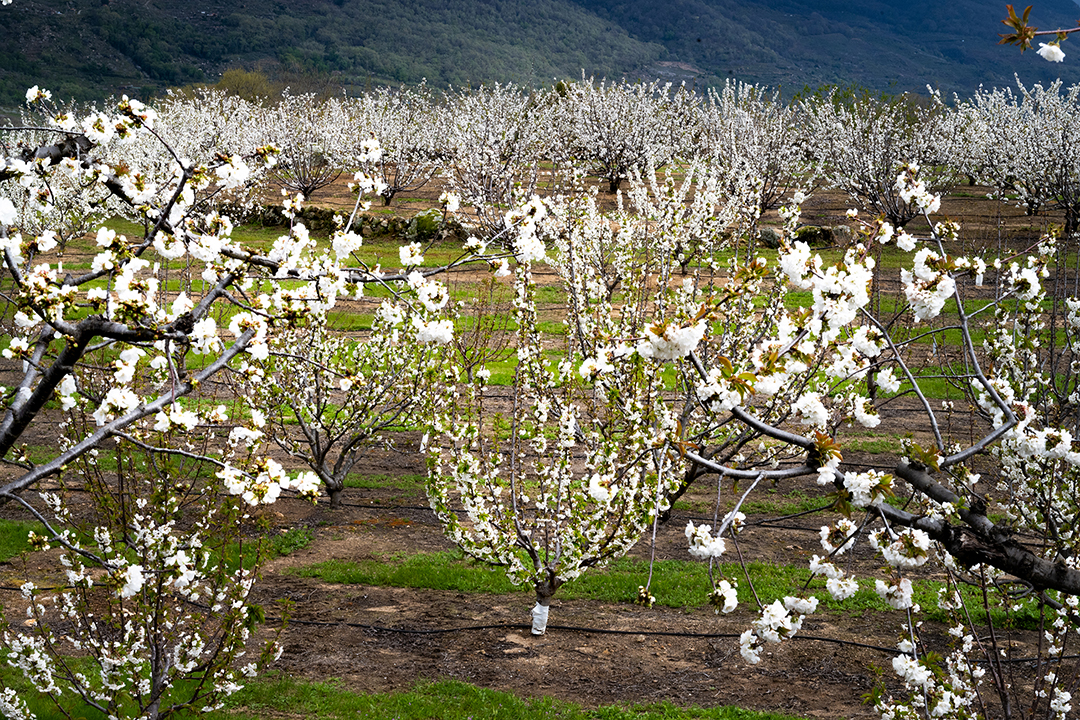
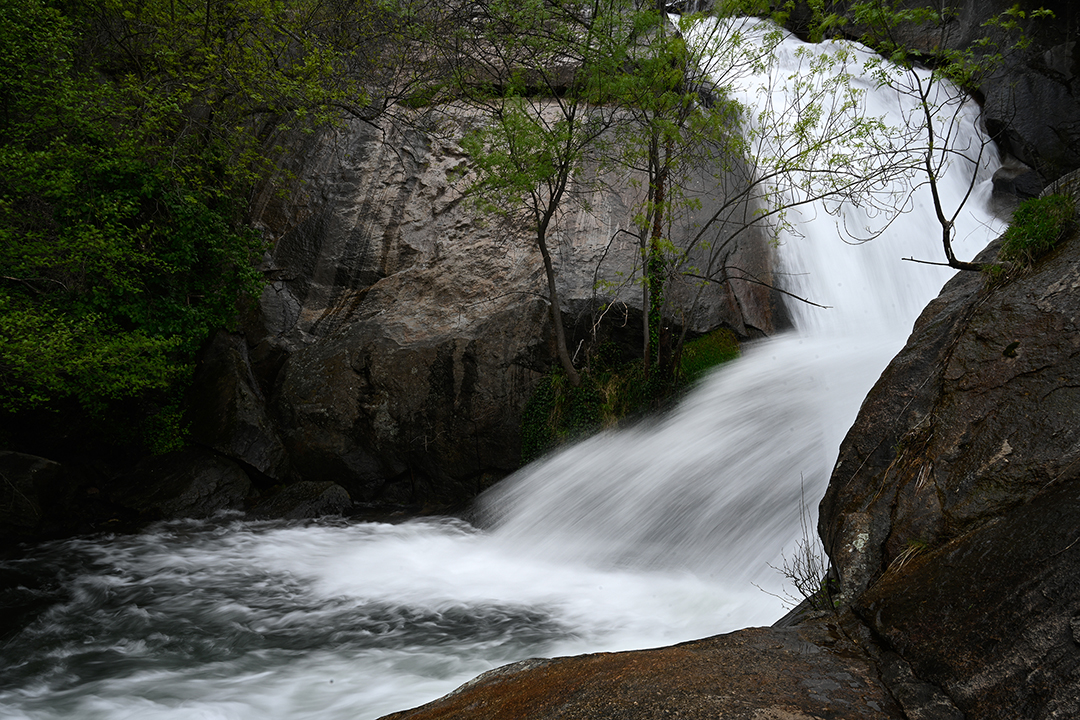
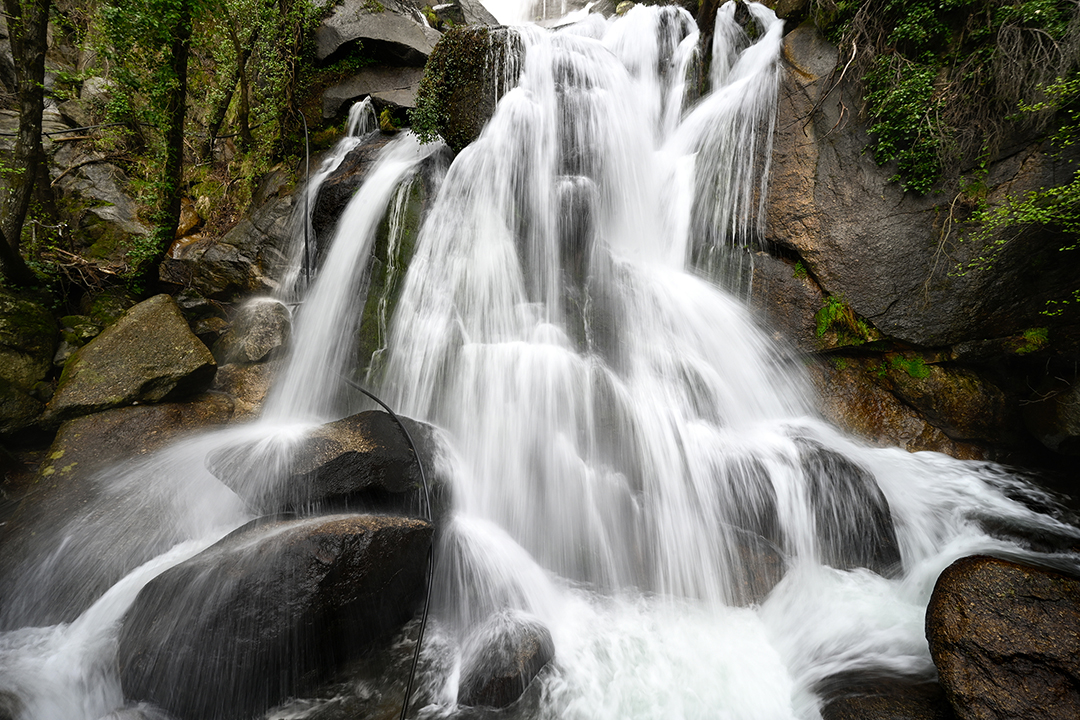
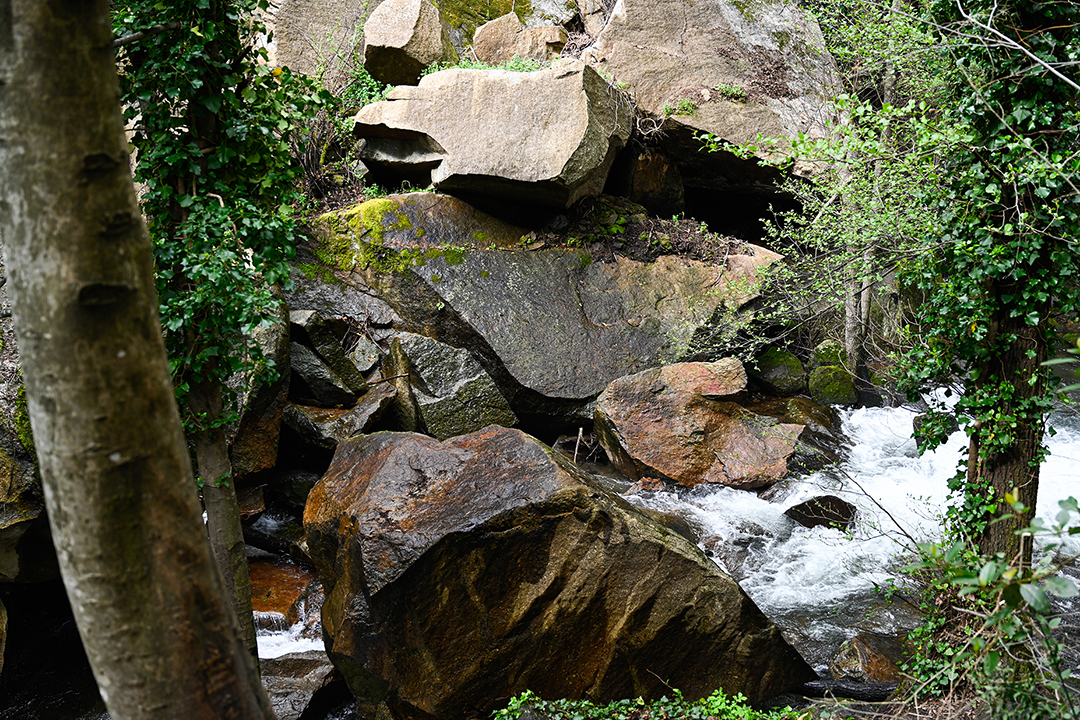
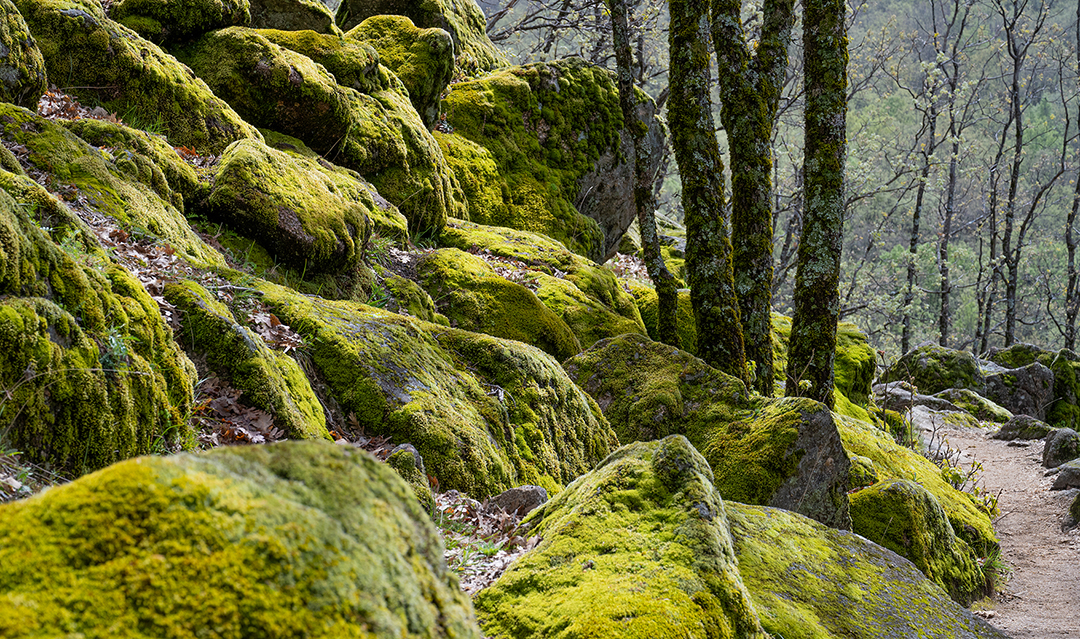
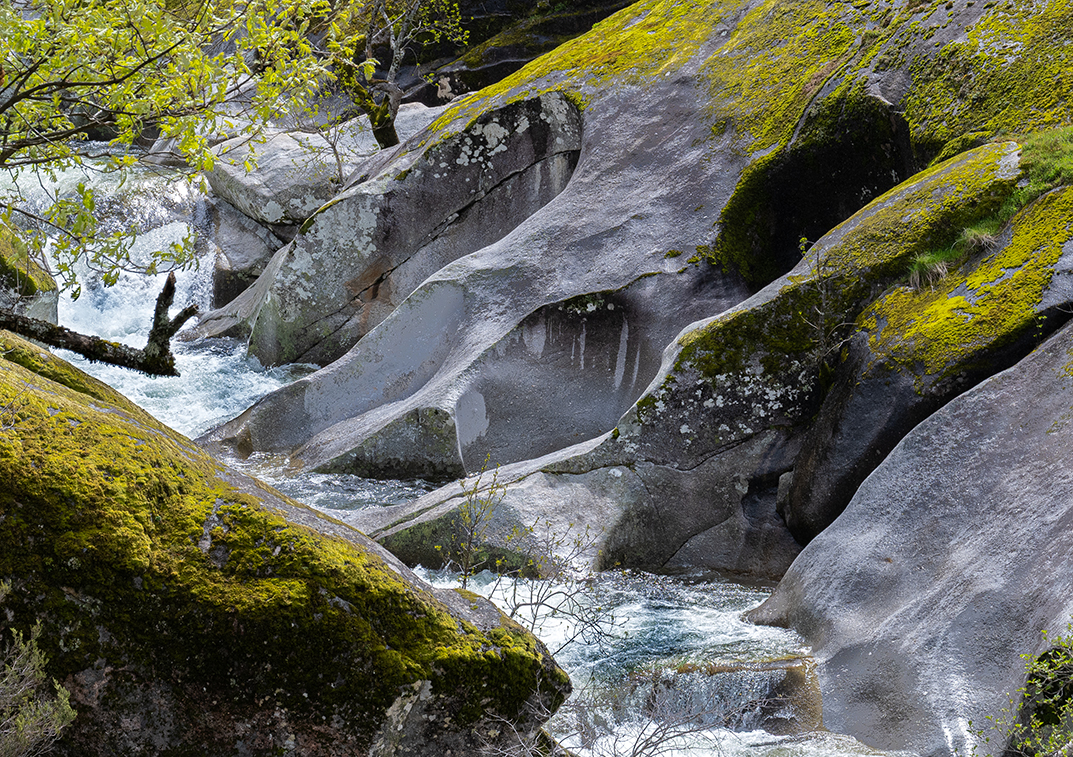
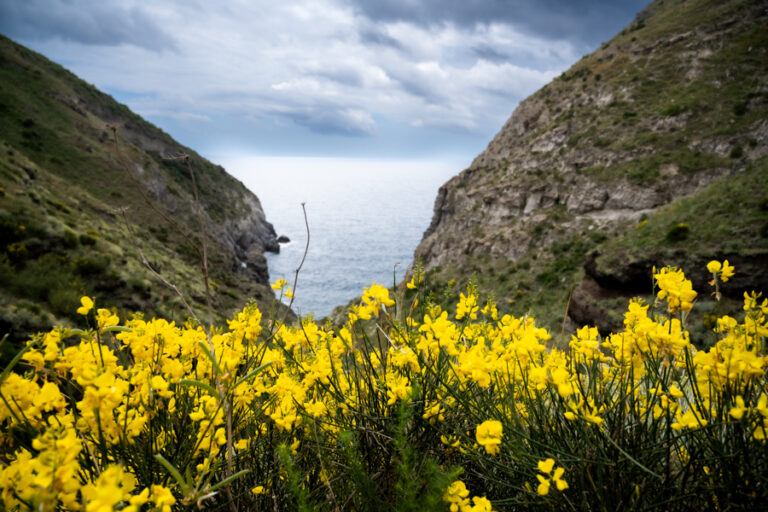
Yet anyone who returns knows that no two experiences are identical. The Spanish refrán that “nunca segundas partes fueron buenas” is not necessarily true, but it does remind us that the second time around the sense of discovery is often attenuated by past experience. That notwithstanding, we were mesmerized… perhaps not quite as much, but, who knows… by our being there then: traipsing through orchards, hiking in the gorges that arise up from the valley floor into the Sierras de Tormantos and Gredos, experiencing directly the force of the waterfalls and torrents, more powerful than ever given the abundant rainfall and snow over the past few months. It is truly hard to convey the magical effect of gazing off into what seems like an unending tapestry of soft, fragrant blossoms… the invitation to reverie is accentuated by all that appeals to the senses: the light streaming through the clouds, the sounds of the water beating against the rocks, the fragrance wafting through the trees, the shimmer of sun on the bright lime green mossy rocks. There is a dimension of the miraculous in this experience that brings to mind, for me, passages from Proust’s In Search of Time Past, which I happen to be reading currently. The narrator’s seemingly religious experience with hawthorns in Cambray is relevant to what we experienced in Jerte:
“I found the whole path throbbing with the fragrance of hawthorn-blossom. The hedge resembled a series of chapels, whose walls were no longer visible under the mountains of flowers that were heaped upon their altars; while underneath, the sun cast a square of light upon the ground, as though it had shone in upon them through a window; the scent that swept out over me from them was as rich, and as circumscribed in its range, as though I had been standing before the Lady-altar, But it was in vain that I lingered before the hawthorns, to breathe in, to marshal before my mind (which knew not what to make of it), to lose in order to rediscover their invisible and unchanging odour, to absorb myself in the rhythm which disposed their flowers here and there with the light-heartedness of youth, and at intervals as unexpected as certain intervals of music; they offered me an indefinite continuation of the same charm, in an inexhaustible profusion, but without letting me delve into it any more deeply, like those melodies which one can play over a hundred times in succession without coming any nearer to their secret” (Marcel Proust, Swann’s Way)
As for Proust’s narrator, the newness of our encounter with the “invisible” and “unchanging” in what is, after all, a profoundly ephemeral and sensual spectacle –the annual floración de los cerezos– was intense, as was its immediacy: a powerful reminder that no medium, no representation, no description or image, can substitute for the immediacy of the here/now. On a deeper level, these moments reminded me once again that the there/then coordinates of our trajectory through space and time can define that trajectory in uniquely meaningful ways, maybe as something of a flow, a continuity, a becoming that is like walking in place.
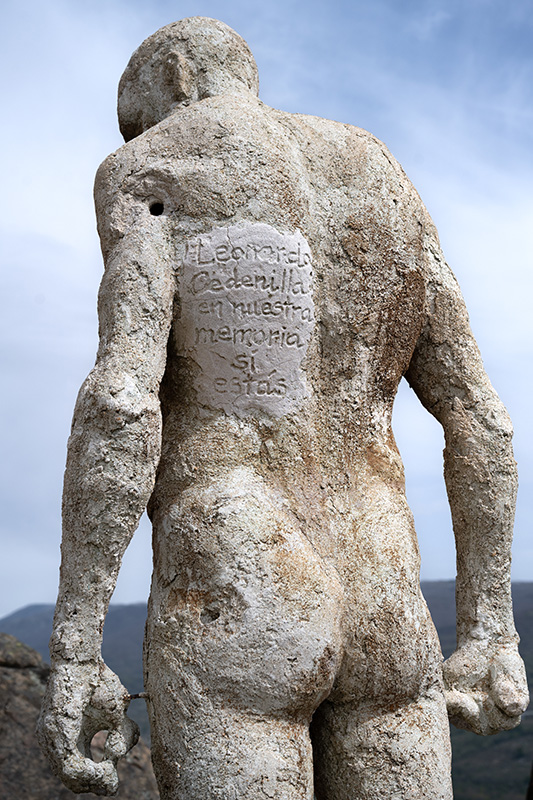
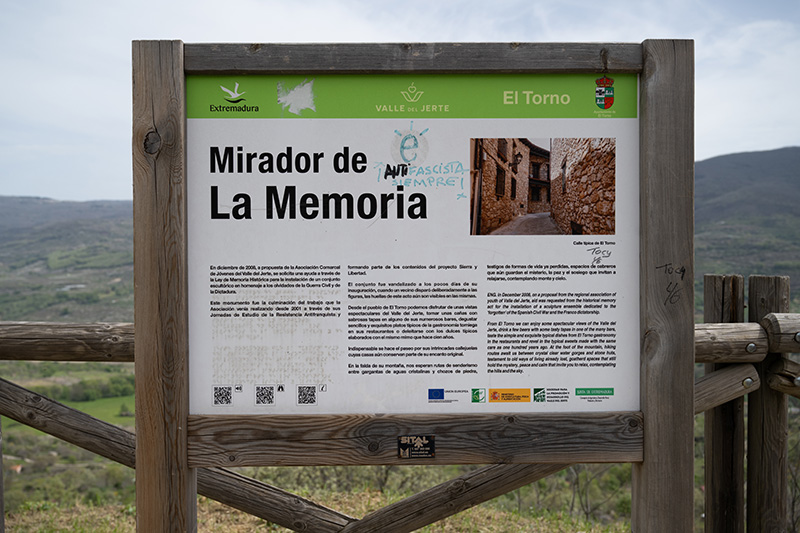
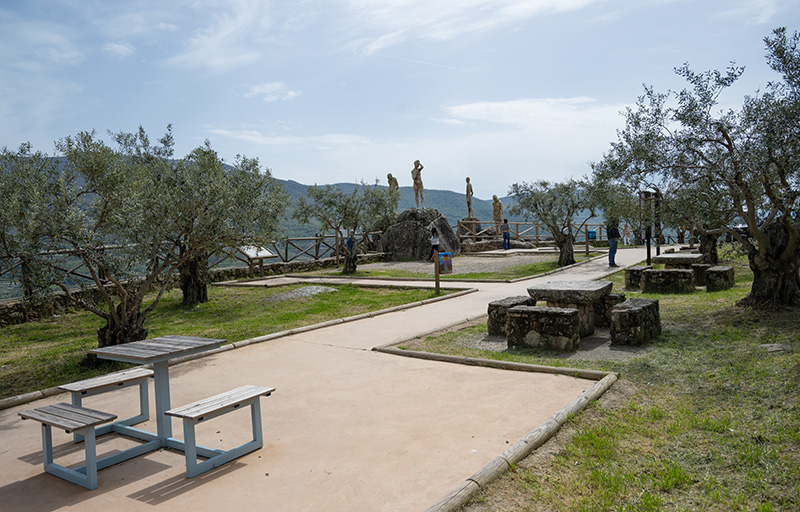
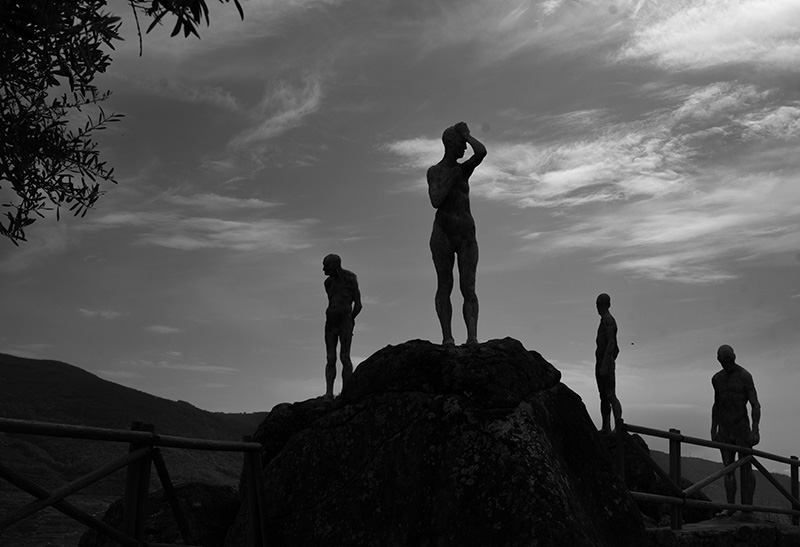
These thoughts merits an afterword. Each time we ascended from the valley floor returning to our lodging in the town of El Torno we would pass by the Mirador de la memoria, a monument erected by a group of local artists erected to commemorate the victims of political violence during and after Spain’s 1936-39 civil war. For reasons having to do with the region’s social history, Extremadura was affected particularly by this violence. This lieu de memoir (site of memory) was established by the regional government to invite people to reflect, perhaps on the fact that human history punctuates the natural flow of planetary homeland in not always positive ways. The monument pays testimony, in short, to the need to reflect.
It is interesting to note that, on the billboard identifying the site, the reference to vandalism that was perpetrated shortly after the artists concluded their work is not translated into English. As the billboard explains, the bullet holes on the human figures are still there to be observed… like the bullet holes on the ceiling of the Spanish parliament, the result of a failed coup-d’etat in 1981.



So happy to have been a part of this adventure!
Me too!
Yes, me too!